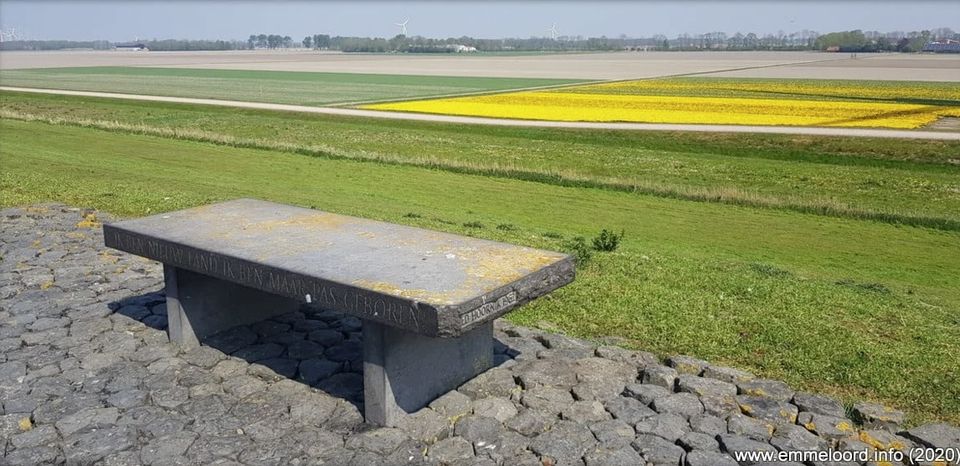
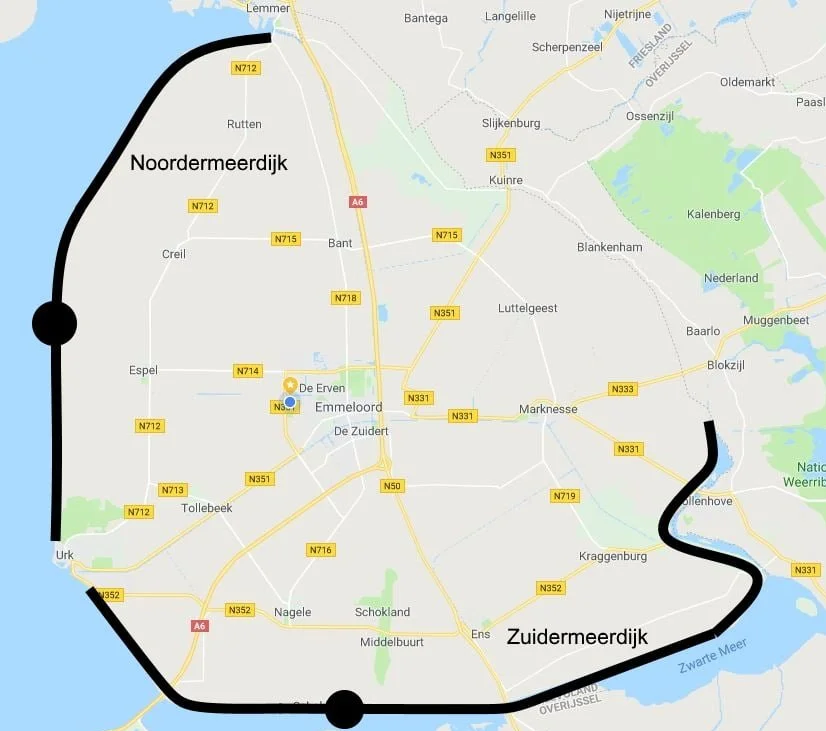
The reclamation of the Noordoostpolder der started by building a dike around the intended new land. Where the Sluitgatmonument of Espel now lies, the section of dike between Lemmer and Urk was closed on 3 October 1939. Hence the term 'Sluitgat'. The closure of the dike is a momentous achievement, which was initially visualised through a commemorative stone 50 years after it was closed. This stone contained the date when the dike was closed.
The commemorative stone was later replaced by a table made of granite during the 10th anniversary of Flevoland Province in 1996. This also records that the dike closure took place at this spot on 3 October 1939. Another text is engraved in the tabletop: the last stanza from Ed Hoornik's poem 'The eleven provinces and the new land'.
Fla...
The reclamation of the Noordoostpolder der started by building a dike around the intended new land. Where the Sluitgatmonument of Espel now lies, the section of dike between Lemmer and Urk was closed on 3 October 1939. Hence the term 'Sluitgat'. The closure of the dike is a momentous achievement, which was initially visualised through a commemorative stone 50 years after it was closed. This stone contained the date when the dike was closed.
The commemorative stone was later replaced by a table made of granite during the 10th anniversary of Flevoland Province in 1996. This also records that the dike closure took place at this spot on 3 October 1939. Another text is engraved in the tabletop: the last stanza from Ed Hoornik's poem 'The eleven provinces and the new land'.
Near Sluitgatmonument Espel, by the way, is also the see-through panel Sluitgat. The see-through panel shows the mayors of Lemmer and Urk shaking hands on a gangplank laid across the Sluitgat on the dike between the two places, after the last heap of soil was dumped into the IJsselmeer there. If you look at the panel from the right distance and angle, the drawing is projected onto the landscape in such a way that it is as if you were there in 1939.
The Sluitgatmonument Espel is easily accessible if you turn off from the Westermeerdijk onto the Zuidermeerpad. That path leads you directly to the Westermeerdijk, where a little further on you can also see the sights Rotterdamse Hoek and vista panel Rotterdamse Hoek. Incidentally, these can only be reached by bicycle or on foot. So be sure to combine these with your visit to the Sluitgatmonument while you are there.
